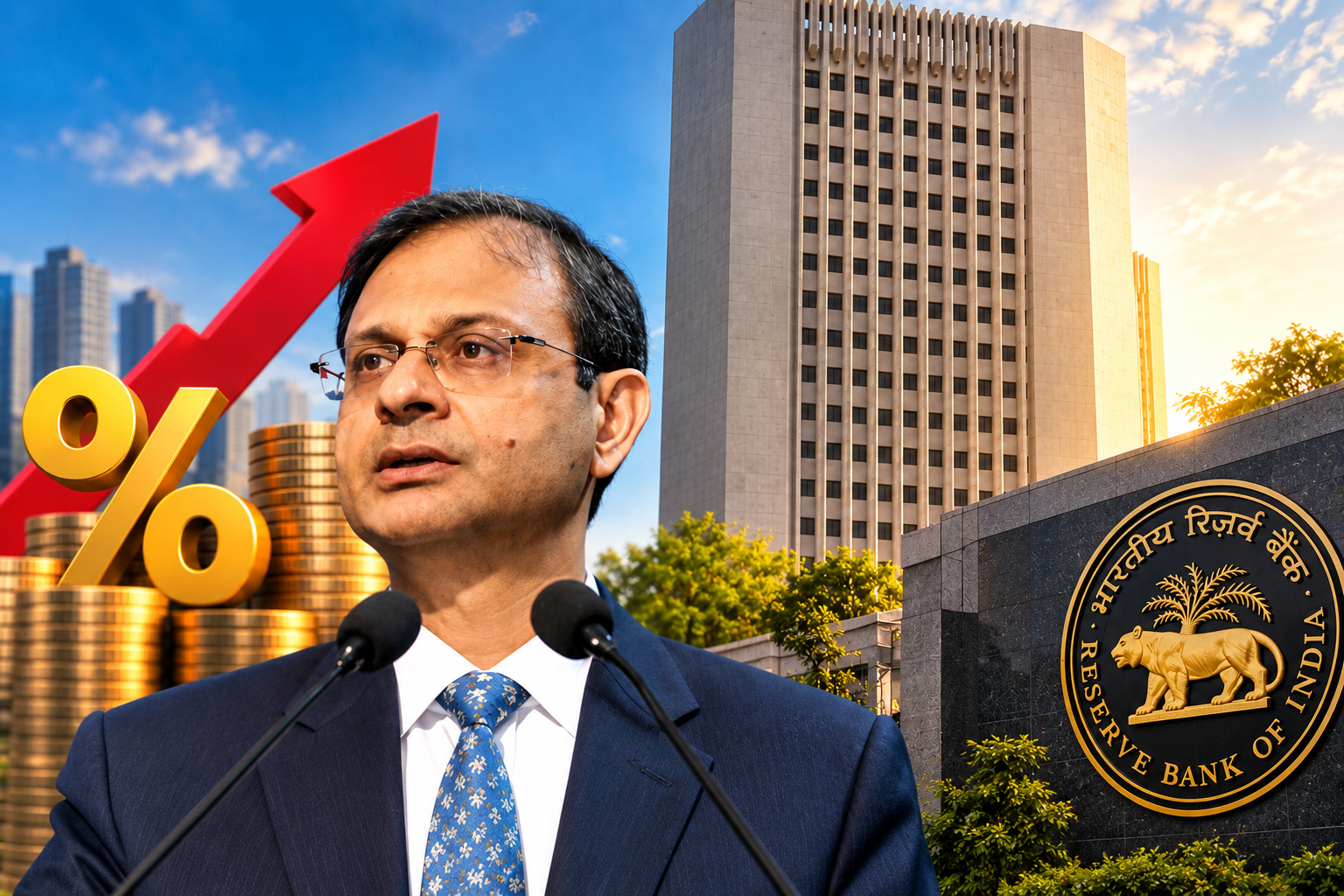
Governor Malhotra flags inflation risks as experts warn of pressure on housing affordability
MUMBAI, Oct 7 (The CONNECT) – The Reserve Bank of India has signalled a decisive shift towards tighter monetary policy, raising the repo rate by 25 basis points to 5.50% and changing its stance from “neutral” to “calibrated tightening”, with RBI Governor warning that inflation risks are no longer benign and that rate cuts are off the table in the near term.
The Monetary Policy Committee’s decision was unanimous. The RBI said the policy recalibration was necessary as headline inflation is expected to average almost 5.8% over the next three quarters, while core inflation is projected at 4.4% for the current financial year.
“Rate cuts are off the table in the near term,” RBI Governor Sanjay Malhotra said, indicating that the policy trajectory ahead will be limited to either another rate hike or a pause, depending on the evolution of growth, inflation and underlying price pressures. The duration and extent of the tightening cycle will depend particularly on the broadening of inflation and the emergence of second-round effects from supply shocks.
The RBI’s move comes against a difficult global backdrop. The renewed escalation of the West Asia conflict has pushed up and increased volatility in global crude prices, while higher bond yields in advanced economies, trade uncertainty and tighter global financial conditions have added to market nervousness.
Yet the central bank remains confident about the resilience of the Indian economy. Real GDP grew 7.8% in Q1 FY27, supported by private consumption and strong investment activity. The RBI has raised its FY27 growth projection by 40 basis points to 7.1%, with growth projected at 7.2% in Q2, 6.9% in Q3 and 6.8% in Q4.
For the real estate sector, however, the immediate concern is affordability.
“The RBI’s 25 bps increase in the repo rate was expected because of the prevailing inflationary pressures and geopolitical uncertainty brought on by the Gulf conflict,” said Anuj Puri, Chairman, ANAROCK Group. He said higher borrowing costs could put pressure on consumer sentiment and discretionary spending, which has a direct correlation with housing demand.
Residential prices in the top seven cities have already risen significantly, further stretching affordability. According to ANAROCK Research, average residential prices increased 7% year-on-year.
Housing sales have nevertheless remained robust. ANAROCK data shows that the top seven cities recorded approximately 1,00,220 housing sales in Q3 2026, up 3% year-on-year and 10% quarter-on-quarter. Affordable housing accounted for 16% of these sales.
Puri said this momentum could now be tested as even a modest increase in EMIs could prompt affordable housing buyers to defer purchase decisions or recalculate their budgets.
Vimal Nadar, National Director and Head of Research, Colliers India, said the increase in the benchmark lending rate could soften near-term demand, but strong underlying fundamentals should cushion the impact across most real estate asset classes.
In residential real estate, buyers are likely to become more selective, particularly in price-sensitive categories. Developers could respond by absorbing part of the financing pressure and offering festive discounts, flexible payment plans and innovative pricing structures.
Shrinivas Rao, FRICS, CEO, Vestian, said the rate hike and the shift to “calibrated tightening” signal a more restrictive monetary policy and reduce the likelihood of rate cuts in the near term. Higher mortgage rates could increase borrowing costs for homebuyers while raising the cost of capital for developers.
Developers, he said, may need to reassess their financing strategies and strengthen balance sheets to manage potential margin pressures and softer demand, particularly if further rate hikes follow.
Piyush Bothra, Co-founder and CFO, Square Yards, however, sees the residential market as considerably more resilient than during earlier rate cycles.
Rising household incomes, urbanisation, improving infrastructure and increasing preference for quality housing continue to support demand. A 25-bps adjustment, he said, is unlikely to fundamentally alter the housing story, particularly for mid-income, premium and well-located projects.
The impact is also unlikely to be uniform across real estate.
Commercial real estate is expected to remain relatively insulated because demand continues to be driven by structural requirements from global capability centres, technology companies, BFSI and other occupier segments, Puri said.
Retail real estate could see more immediate caution. Higher financing costs, combined with the possibility of softer festive consumption, could make developers and investors more cautious, with some new mall projects potentially being deferred until demand becomes clearer.
The financial markets are also expected to absorb the move without major disruption because the hike was broadly anticipated.
Vaqarjaved Khan, Senior Fundamental Analyst, Angel One, said the 25-bps hike and the shift to calibrated tightening represented a meaningful change in the policy cycle, with inflation risks taking greater precedence.
August CPI inflation rose to 4.8% from 4.5% in July, driven largely by food and fuel prices, while core inflation also increased. The RBI expects CPI inflation for FY27 to average 5.2%, with inflation projected at 6% in Q3 and 5.7% in Q4.
Rajeev Radhakrishnan, CFA, CIO – Fixed Income and Head of Research (Fixed Income), SBI Mutual Fund, said the policy recalibration was broadly along anticipated lines, while the change in stance provided guidance on the future trajectory of rates.
The absence of specific measures to normalise liquidity, he said, is likely to keep overnight rates below the repo rate, with the burden of liquidity normalisation potentially falling on additional open-market sales in the near term.
The RBI said system liquidity had averaged a surplus of ₹5.9 lakh crore since its previous MPC meeting, while credit growth remained robust and broad-based. It said it would use an appropriate mix of liquidity-management tools to align the weighted average call rate with the policy repo rate.
For banks, the focus could now shift towards defending net interest margins as deposit repricing accelerates. Khan expects the market impact to remain selective, with rate-sensitive sectors facing pressure while banks with stronger balance sheets and liability franchises could be relatively better placed.
Akhil Saraf, Founder and CEO, Reloy, said India’s relative stability and the measured nature of the repo-rate hike were reassuring against the backdrop of pressure in global bond markets.
For real estate, Saraf believes the broader macroeconomic stability could ultimately be constructive. While borrowing costs may rise marginally, greater certainty could encourage homebuyers to proceed with long-term purchase decisions.
The RBI itself has emphasised that the Indian economy remains resilient despite significant global headwinds. It expects sustained services activity, stable employment, government infrastructure spending, a rebound in private capital expenditure and strong credit flows to support domestic demand and investment.
The bigger message from the latest policy decision, therefore, goes beyond the 25-basis-point increase.
For homebuyers, the immediate effect is likely to be higher borrowing costs and greater scrutiny of affordability. For developers, financing discipline and balance-sheet strength will become more important. For investors, the RBI’s new stance signals that an early return to an easing cycle should not be assumed.
India’s real estate market is entering this phase from a position of relative strength, but the next leg of growth is likely to be more selective. Affordability, project quality, developer balance sheets and the ability to offer flexible pricing could increasingly determine who sustains demand in a higher-rate environment.