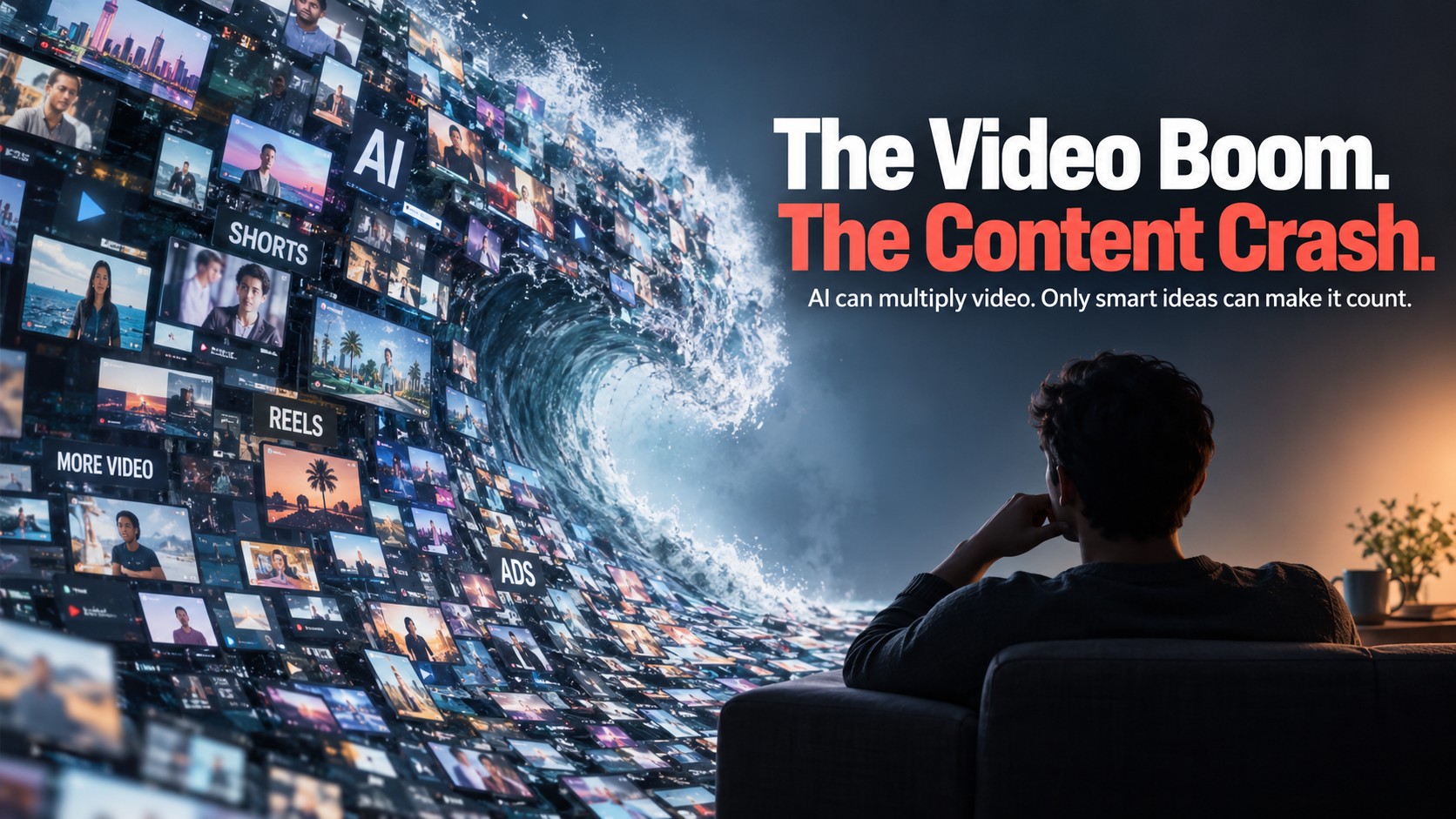
Subhead: AI can multiply video. Only smart ideas can make it count.
By TORREY TAYENAKA
Most video trend reports begin with what is easiest to see: a new format, a new platform habit or a new production tool. That is understandable. Those are easy to name.
But the changes that matter most often show up somewhere else first — in the brief, the budget, the request for “just a few more versions,” or the realisation, two weeks after a shoot, that the footage cannot do what the media plan now requires.
The bigger shifts are happening in how video is scoped, approved, produced, stretched and, sometimes, overused.
The Industry Is About to Produce a Lot More Forgettable Video
AI is removing friction from video production. Not all of it, but enough to change expectations.
Rough concepts can be built faster. Voices can be replaced. Backgrounds can be cleaned up. Edits can be reformatted. Localisation is becoming easier. Internal teams will reasonably ask why output should not increase.
It will.
The harder question is what happens next.
Every new asset still needs a purpose, a channel, an owner and an approval path — usually followed by three opinions arriving after version one. Cheaper production does not make those decisions disappear.
That is the uncomfortable side of abundance: a huge volume of new video will be technically acceptable, brand-compliant and almost completely interchangeable.
The Valuable Skill Will Be Stopping Earlier
The advantage will not belong to the team that can generate the most. It will belong to those who can spot a dead idea before it becomes a deliverable.
That may mean killing a concept because it works only as a visual gimmick. Or recognising that twelve versions are not actually twelve ideas. Or admitting that a treatment already feels tired, even though the tool producing it is new.
Production is getting easier. Selection is not.
Short-Form Video Will Lose Some of Its Excuses
Weak short-form work has often been protected by the format itself. It is supposed to be fast, casual and frequent. None of those ideas is wrong, but they have been used to defend a surprising amount of content that has little to say.
Audiences are recognising the machinery.
The oversized captions. The fake podcast framing. The pause before the supposedly “unexpected” opening line. The unnecessary punch-in on a sentence that did not need emphasis. The attempt to borrow a creator’s rhythm without borrowing the credibility that made that rhythm work.
Short-form is becoming less forgiving — not necessarily more expensive or more polished, just more specific.
The videos that hold up will usually contain something concrete: a product behaviour, a strong comparison, a small reveal or an opinion with some risk behind it.
Posting frequency will still matter. It just will not cover for thin thinking as effectively as it once did.
The Most Useful Footage May Be What Nobody Asked For Yet
Production still tends to begin with a list of final deliverables: one main video, a 30-second cutdown, three social versions and perhaps some stills, depending on time.
That list rarely survives contact with the campaign.
Paid media wants different hooks. Sales needs a version that gets to the point faster. The web team needs a clean product action without graphics over it. Someone decides vertical matters after all. The best line begins with, “As I said earlier,” making it impossible to use on its own.
None of this is unusual.
Smarter shoots are beginning to leave room for requests that have not arrived yet. That does not mean filming endlessly.
It means holding a shot after the obvious action is complete. Capturing the product without a hand covering the key feature. Recording an answer that does not depend on the preceding question. Shooting a clean ending that is not tied to a date, offer or event.
Small decisions. Expensive consequences later.
Editors Cannot Invent Coverage
Repurposing is often described as a post-production strategy. Most of the time, it is decided on set.
By the time footage reaches an editor, the useful options are already fixed. Either there is a clean opening or there is not. Either the frame survives a vertical crop or it does not. Either the demonstration was captured clearly or the edit has to conceal the missing step.
The editor gets blamed because the limitation becomes visible in post.
The limitation usually began earlier.
Personalisation Will Work Better When It Is Less Obvious
The industry tends to favour the most dramatic version of personalisation: a unique video for every viewer, generated dialogue, swapped visuals or a presenter who appears to know exactly who is watching.
Some of that will be useful. Some of it will feel like a technical demonstration looking for a business case.
The more practical shift is simpler.
Someone seeing a product for the first time needs a different opening from someone comparing specifications. A returning customer does not need the same explanation as a buyer who barely understands the category. Someone on a product page has already crossed several mental thresholds before pressing play.
That is where personalisation becomes useful.
Context is usually more valuable than personalisation that announces itself. The best version may not feel customised at all. It may simply avoid explaining the wrong thing at the wrong time.
That sounds modest. In practice, it is where a lot of video loses people.
Social Video Is Moving to Screens It Was Never Designed For
Plenty of mobile-first video is now watched from a couch. YouTube, creator shows, video podcasts, ads, interviews and streaming content can all land on the same television.
The delivery environment is converging faster than the creative rules.
The result can be strange. Captions designed for a phone can take over an entire TV screen. Loose handheld work that feels immediate on mobile can become tiring when enlarged. A polished brand film can look beautiful and still feel slow beside creator content watched in the same session.
This does not mean everything is becoming one format.
It means brands can no longer define a video simply by where it was uploaded.
Viewing distance matters. So do sound, text scale, framing and pacing. The first five seconds can work differently depending on the screen and the context.
One idea may travel.
The edit may need to change more than the marketing team expects.
The Videos That Keep Working May Look Small at First
The industry naturally notices spikes. A launch video performs well. A short gets shared. A campaign produces a clean increase in traffic during the reporting window.
Useful video does not always arrive that loudly.
A product comparison may accumulate views slowly for two years. A setup video may prevent the same support question from being asked hundreds of times. A detailed demonstration may help a buyer who is already close to purchasing while generating very little visible engagement.
The opportunity lies in video built around recurring uncertainty.
Sales teams know where buyers hesitate. Customer service knows which step causes confusion. Reviews reveal what people misunderstood before purchase.
Those questions often sit outside the “creative” conversation.
That is part of the problem.
Searchable video libraries will matter more as discovery spreads across social platforms, search engines, retailer pages, AI tools and brand websites. Some of the strongest assets may look ordinary in the first monthly report.
Trust Will Depend on What Brands Choose Not to Hide
“Authenticity” has become too broad a word to be especially useful.
A video can be handheld and evasive. It can feature a real employee and still sound painfully rehearsed. It can be beautifully produced and completely honest.
Trust comes down to what is actually shown.
Can the viewer see the feature working? Does the demonstration continue through the part that proves the claim? Is the result clear, or buried under edits, graphics and reaction shots? Does the speaker understand the product well enough to depart from the script?
These choices already matter. They will matter more as synthetic footage becomes commonplace.
The dividing line will not simply be AI versus live action.
A generated visual can explain something accurately. A real camera can be used to avoid showing the one detail a buyer actually needs.
Trust is often built in the unglamorous shot: the extra angle, the uninterrupted process, the few seconds left after the marketing point has already landed.
The Next Advantage May Be Refusing More Work
There is a tension the industry rarely discusses. Brands will have more ways to produce video, more places to distribute it and more reasons to create another version.
Every new tool makes addition easier.
Another crop. Another hook. Another platform-specific edit. Another asset pulled from the same shoot simply because the footage already exists.
At some point, the work gets wider and thinner.
Production teams see this early. The folder grows. The approval chain gets longer. More hours go into version control, exports, captions, file names and minor revisions that do little to improve the viewer’s experience.
The next meaningful advantage may be selectivity.
Knowing when a format deserves its own concept rather than a resize. Knowing when an extra version adds nothing. Knowing when a trend has no relationship to the product, the customer or the way the company actually sells.
The industry will make more video.
The stronger operators may become easier to recognise by what they decline to make.
About the Author
Torrey Tayenaka is co-founder and CEO of Sparkhouse, an Orange County-based commercial video production company. He contributes expertise to publications including Entrepreneur, Single Grain and Forbes.
Sparkhouse focuses on turning video marketing and advertising into real conversations, creating interesting, entertaining and useful content rather than relying on overt advertising. Tayenaka has also founded Eva Smart Shower, Litehouse and Forge54.